 CUISINE
 HISTORY
 JOURNALS
 PEOPLE
 CONSERVATION
The Acrobat : Malabar Giant Squirrel
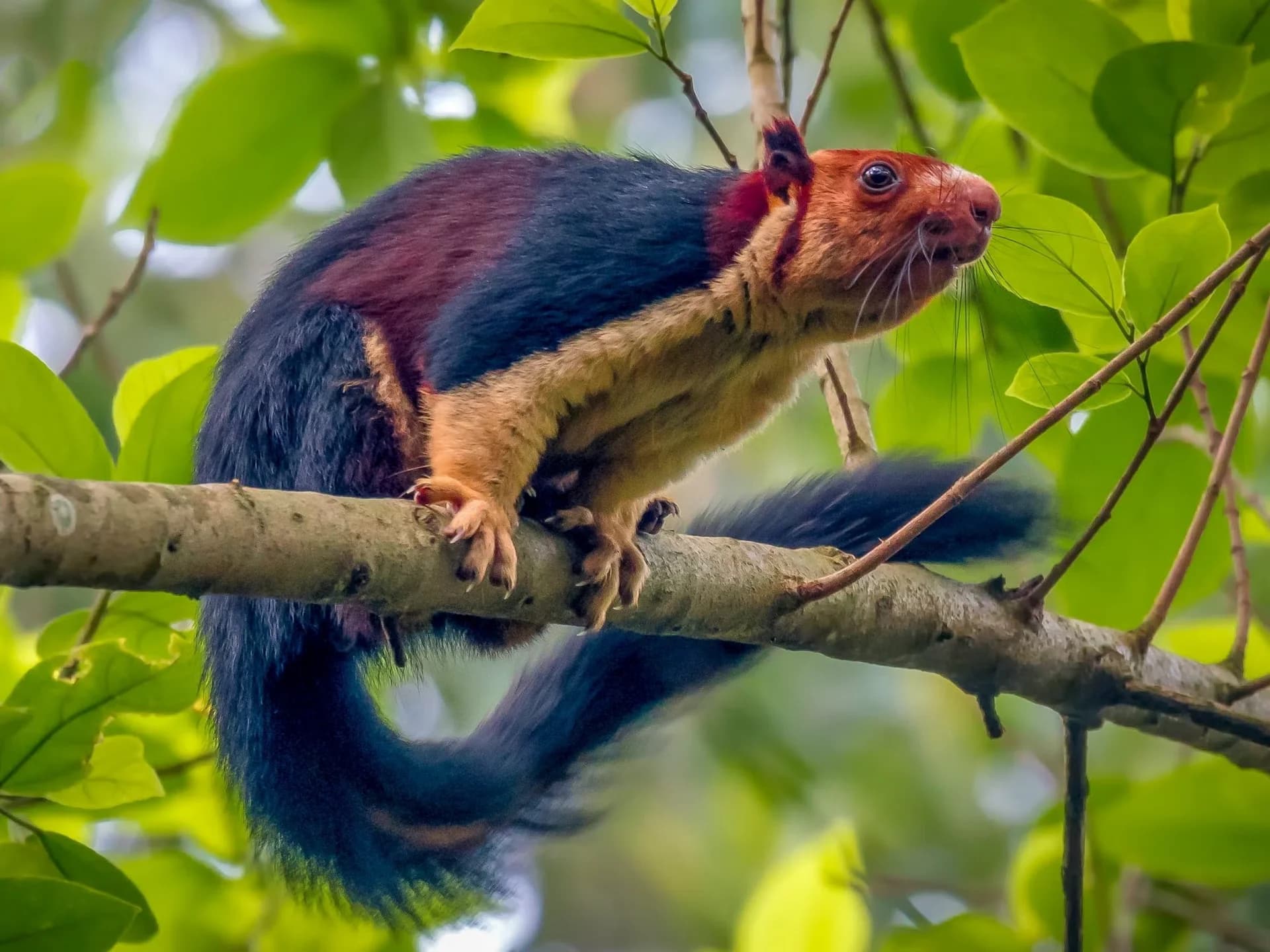
High above the tea bushes and pepper vines of our estate in Wayanad, a sudden rustle rearranges the silence. Leaves tremble. A branch bends with intention. Then he appears, stretched across the green architecture of the Western Ghats like a streak of moving color. The Malabar giant squirrel, scientifically known as Ratufa indica, does not resemble the small nervous squirrels of town compounds. He is larger, deliberate, almost theatrical. His fur carries unexpected shades of maroon, burnt orange, beige and deep chocolate brown. In certain light he looks hand-painted, as if the forest hired him to add contrast to its endless green. We see him often in the estate. So often that it feels as though he reports for duty. A paid artist of the canopy. He rehearses his movements with a seriousness that makes you want to applaud. There is something faintly comic about the way he stretches his body before a leap, tail lifted like a question mark, head tilted in calculation. He studies the distance, the wind, the bend of the branch. Then he launches. For a second he is airborne, an arc of fur against the sky. The Malabar giant squirrel of Kerala is endemic to India and thrives in the tall forests of the Western Ghats. Unlike ground-dwelling species, he spends almost his entire life in the trees. He can leap several meters between branches, using his long bushy tail for balance. Adults can grow up to three feet in length including the tail, making them one of the largest squirrel species in the world. He builds large, globular nests high in the canopy, woven from twigs and leaves. Sometimes there are several nests within his territory, each carefully chosen for safety and vantage. From up there he feeds on fruits, nuts, bark, flowers and seeds, occasionally insects. In feeding, he becomes a silent planter of forests, dispersing seeds across distances that no human hand could manage. The Malabar giant squirrel plays a crucial ecological role in maintaining the biodiversity of Wayanad and the wider Western Ghats ecosystem. Yet beyond facts and forest data, there is personality. He hangs upside down with the casual arrogance of a seasoned performer. He pauses mid-branch to chew, eyes bright, as if aware of being watched. There is mischief in his stillness. A Basheer-like humor in his presence. A Nerudian lyricism in the way his tail writes curves in the air. And somewhere in that canopy, a quiet reminder that forests are not scenery but living republics, each citizen necessary. When guests join us for a plantation walk in Wayanad, we speak of birds and mist and the smell of wet earth. But secretly, we hope they look up at the right moment. Because seeing a Malabar giant squirrel in the wild is not just wildlife spotting. It is an encounter with movement made elegant by necessity. He does not rush. He does not descend to prove himself. He remains in the heights, trusting the branches that have held generations before him. His stage is unbroken canopy. When forests are fragmented, his leaps become dangerous. When old trees fall, his theatre collapses. Today he crossed from the jackfruit tree near the bungalow to the tall silver oak beyond the lawn. A clean, confident arc. No applause. No curtain call. Only the wind adjusting itself after his passage. And below, in the estate, we stand humbled by a creature who turns survival into art, who makes the everyday act of moving through trees feel like a performance written by the forest itself.